Operator organization
Industrial, institutional or rescue work with a robot and a trained operator.

We develop robot-agnostic, primarily VR-based teleoperation systems: know-how, technology, interface and UX – with integration verified robot by robot.
 Simulation – real application recording
Needed where the task is remote, hazardous or not yet automatable – but needs human judgement.
Industrial, institutional or rescue work with a robot and a trained operator.
A shared operator layer for several robot platforms, with adapters and testing.
The same interface for practice on an emulated robot, then in the field.
Every input takes the same validated path: keyboard, VR, voice, AI plan and instructor.
Measured, estimated and missing data are labeled apart. Click the numbers.
 Simulation – real application recording
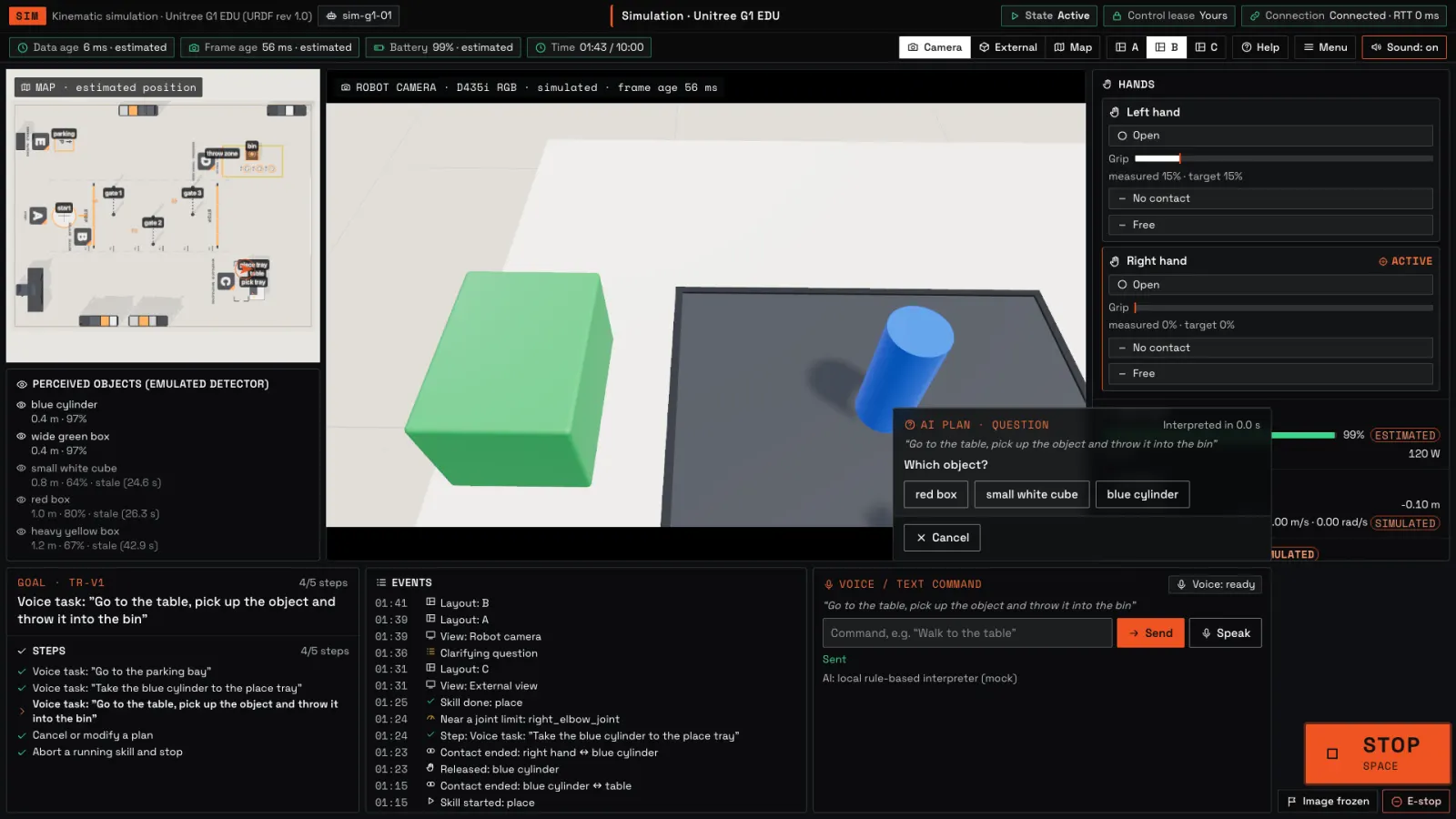
Profile B – operator control desk: map, robot camera, perceived objects, robot state, steps, events – simulation
Being in the catalog implies no integration level by itself.
| Function | Unitree G1 EDU | Other catalog robots |
|---|---|---|
| Kinematic model | SimulatedR1 training: URDF-accurate geometry, joint limits, speed limits, self- and environment collision; main dimensions within 1% of factory values. No dynamics (balance, falls, forces). | Catalog data |
| 3D model | 3D modelCode-built, fully articulated model using the official URDF kinematics – our own work, not a vendor mesh. No 3D viewer on the website yet. | Catalog data |
| Walking (velocity request) | SimulatedEmulated gait within the walking limits. Known deviation: at start-up the leg joint speed can exceed the URDF limit (measured 39.7 rad/s vs 20 rad/s). | Catalog data |
| Arm control (IK) | SimulatedMouse and keyboard on a laptop, clutch in VR. An unreachable target causes no jump or joint-limit violation (tested). VR verified only in the IWER emulator. | Catalog data |
| Hand and grasp (Dex3, single hand) | SimulatedGeometric grasp without force simulation, within the training profile limits (80 mm hand opening, 3 kg per arm). No bimanual grasp – planned (R2). | Catalog data |
| Head camera (D435i) | SimulatedClient-side render following the camera profile: 69° × 42° field of view, 47.6° downward tilt. The image is not a real camera stream. | Catalog data |
| Fault handling (latency, freeze, dropout) | SimulatedSimulated network profiles and one-off events; stale late commands are discarded by the core, a frozen image is clearly flagged (tested). | Catalog data |
| Unitree SDK adapter | PlannedR4: the command mapping to the unitree_sdk2 G1 interface exists as a plan (locomotion, arm, Dex3, state); to be verified on firmware and SDK version. | Catalog data |
| Test on a real robot | PlannedNot done yet. It needs the robot, firmware, peripherals, on-site supervision and a per-robot acceptance test. | Catalog data |
Catalog data – integration after a per-robot assessment · Robot Catalogue →
Every step has a precondition and a log; a failed calibration blocks the start.
 Simulation – real application recording
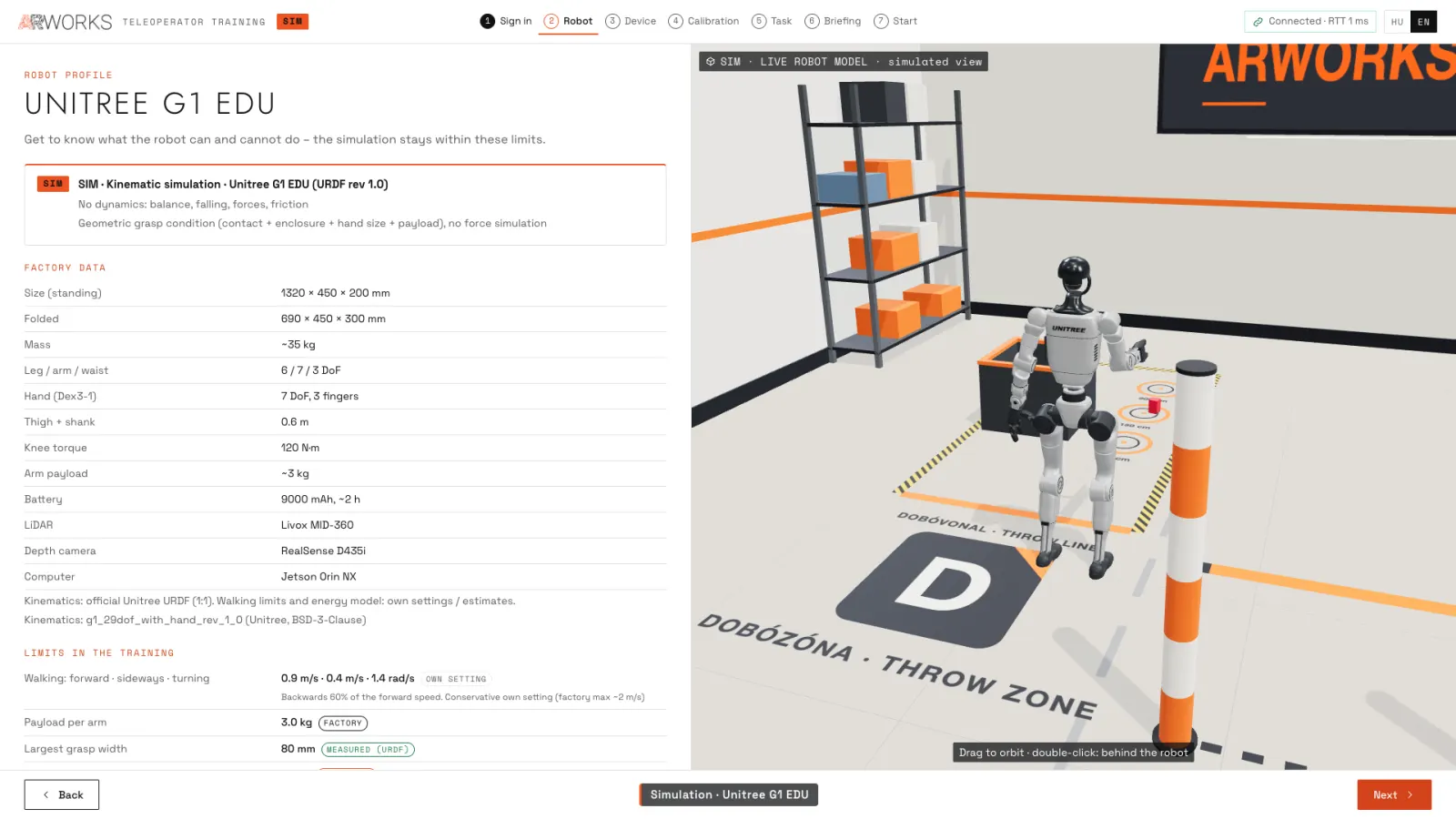
Robot, profile and capabilities: a robot card with factory and measured data.
Done in simulation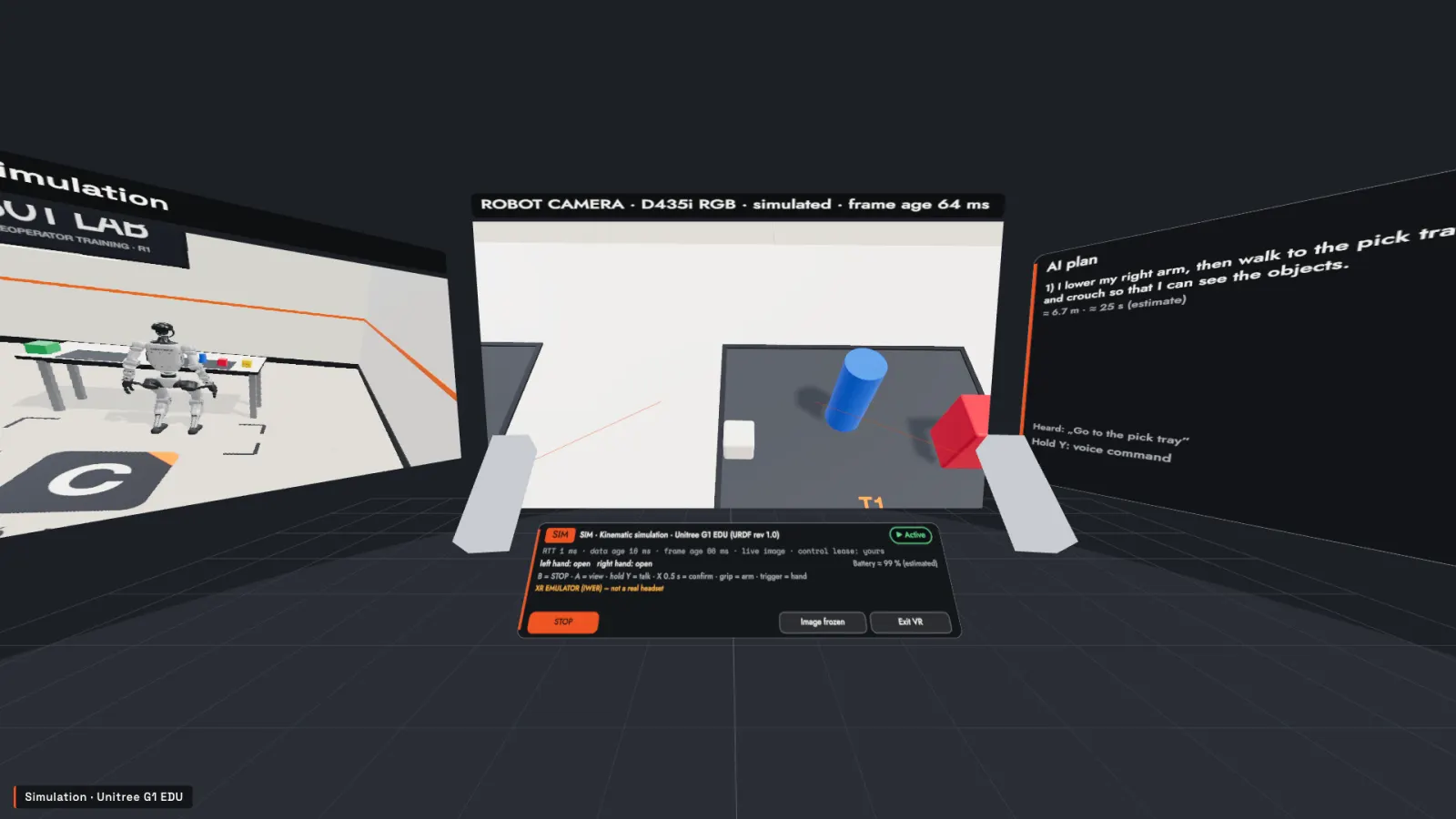 IWER emulator – not a real headset
Device and direction test, then activation by holding for 1 second.
Done in simulation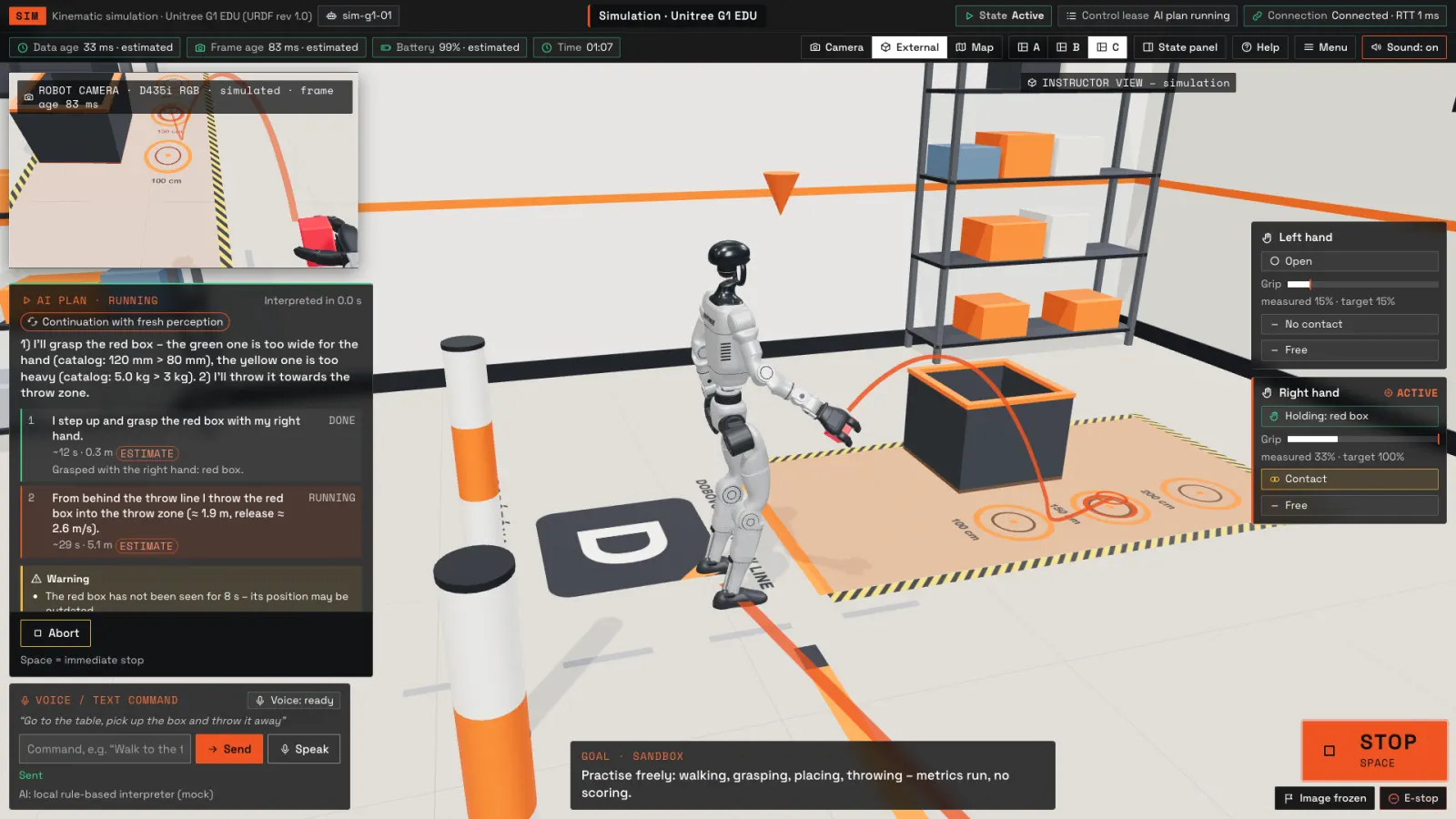 Simulation – real application recording
Walking, manipulation, commands – the control lease belongs to one source.
Done in simulationLogged, jerk-free, explicitly accepted operator change.
Planned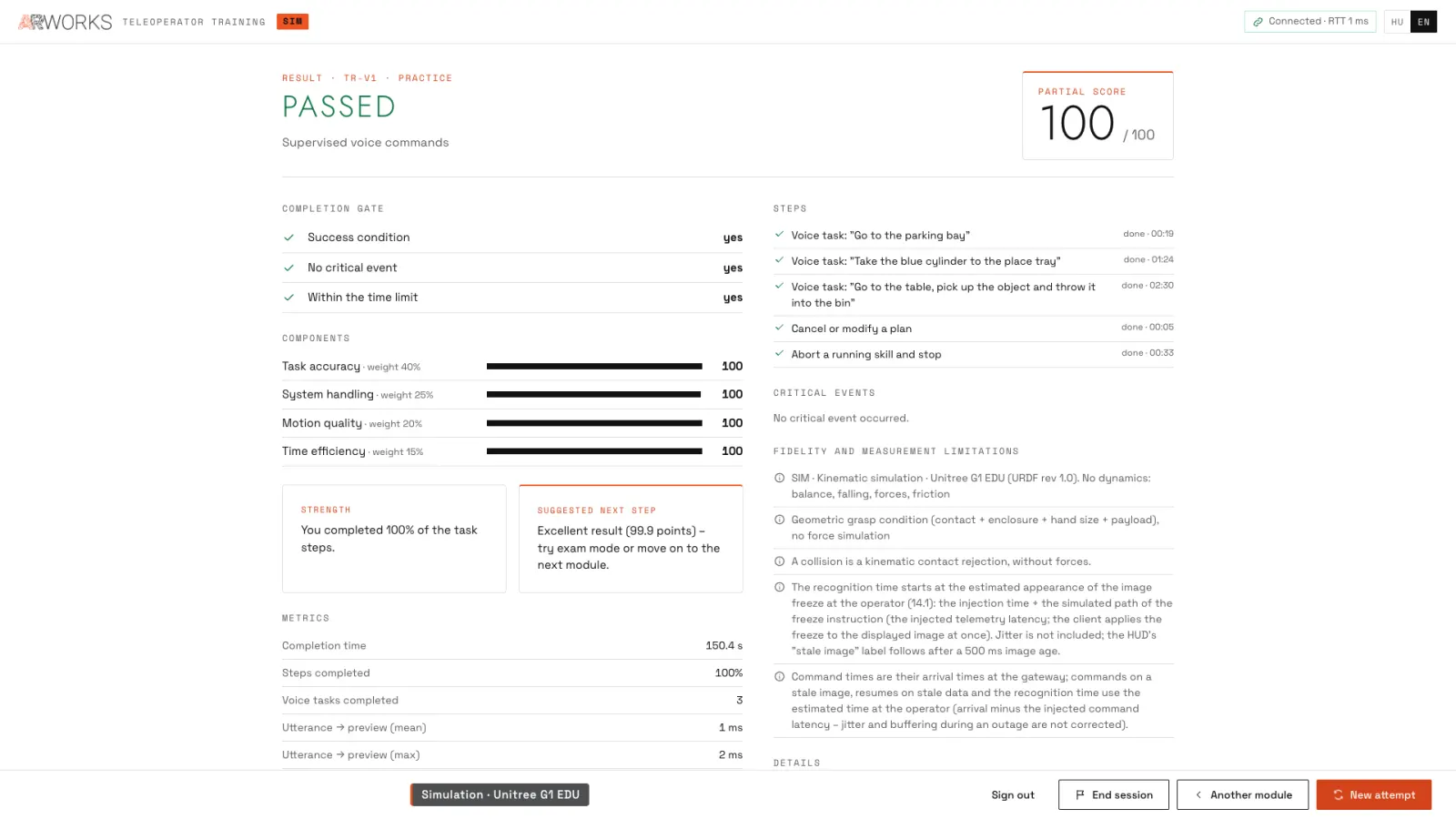 Simulation – real application recording
Result, log, export – the attempt can be replayed.
Done in simulationBalance and motor control run locally. Drag the slider: what changes, and what does the local guard protect?
Illustrative profiles from the training’s fault injector – not a measured real network.
On a real robot the local procedure must be validated per robot.
Command, feedback, fault and configuration on one timeline – replay is always virtual.
The AI sends no motor commands: it can only request approved, parameter-limited skills, with a preview.
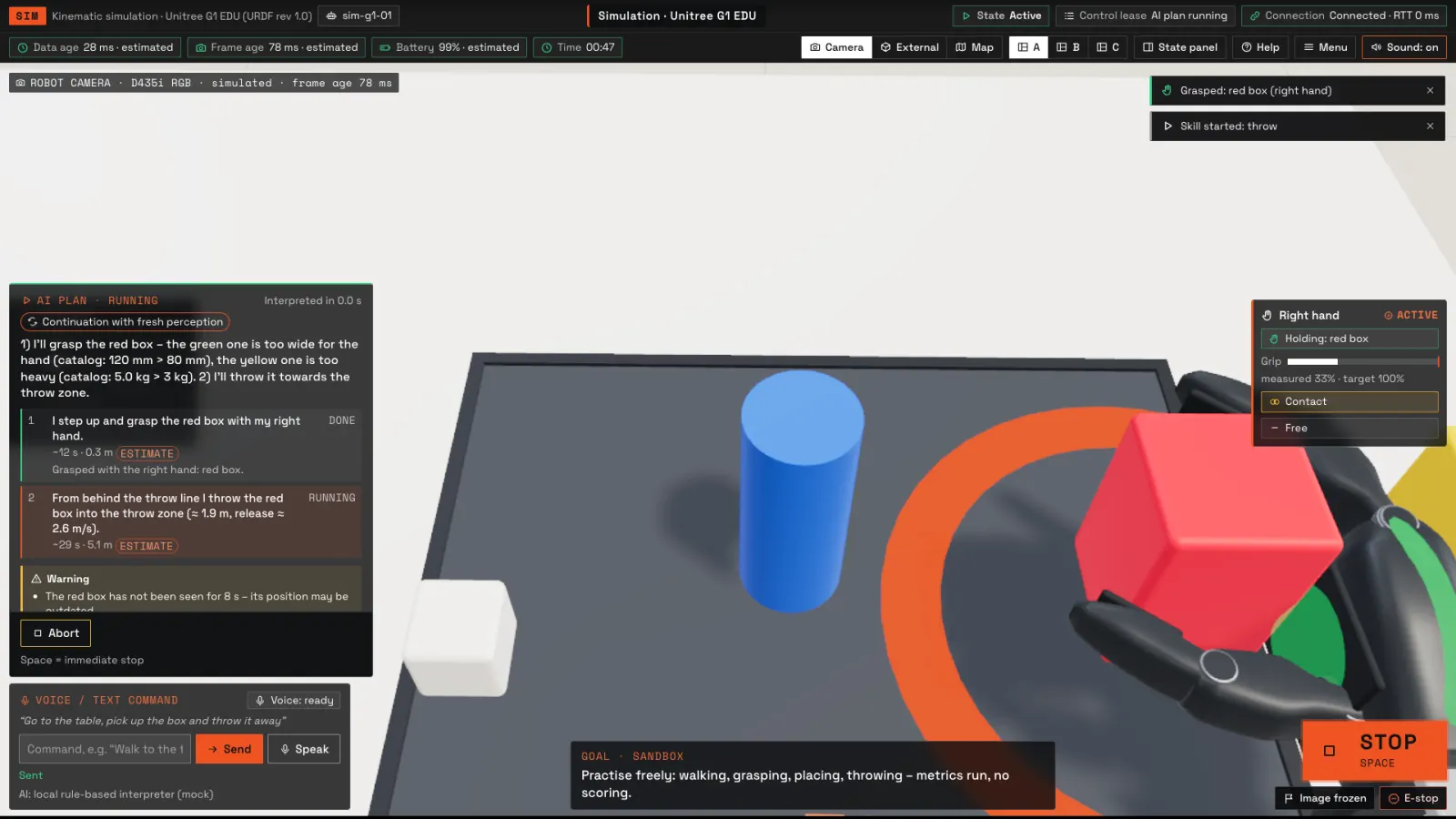
 Simulation – real application recording
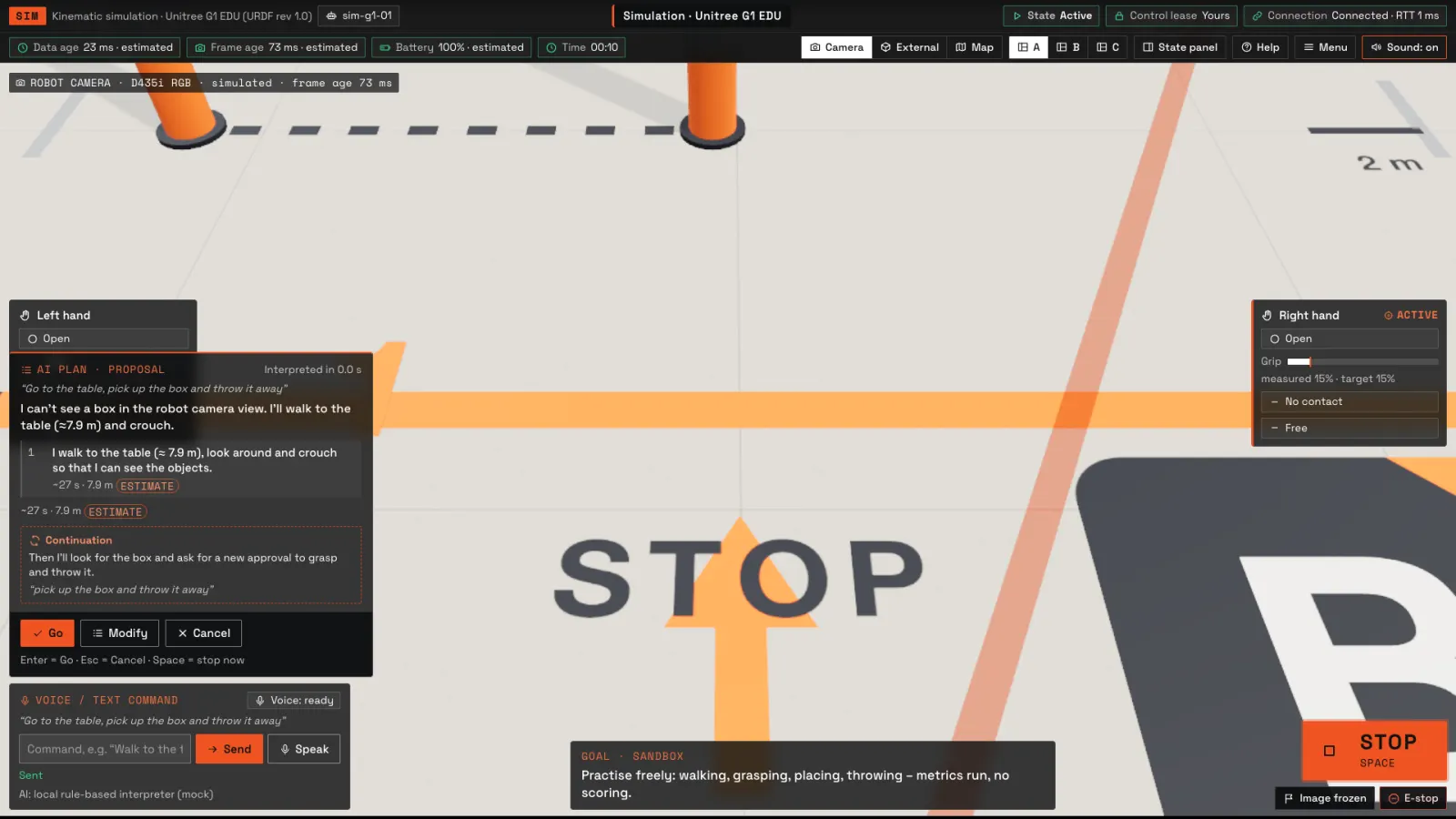
“Go to the table, pick up the box and throw it away.” The box is not yet visible, so the plan starts with walking there.
 Simulation – real application recording
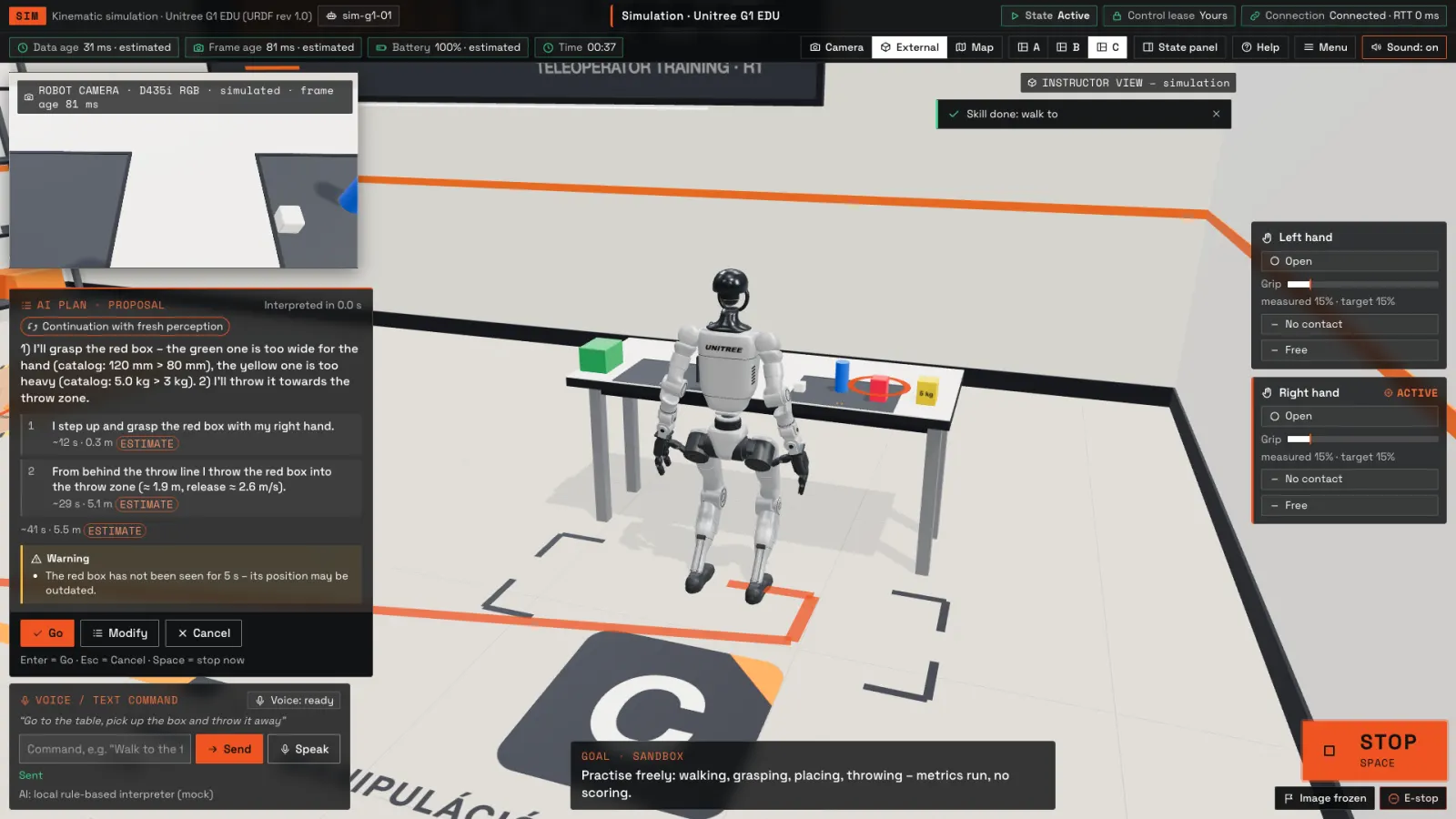
At the table a new preview: it picks the red box, because the yellow one is too heavy and the green one too wide.
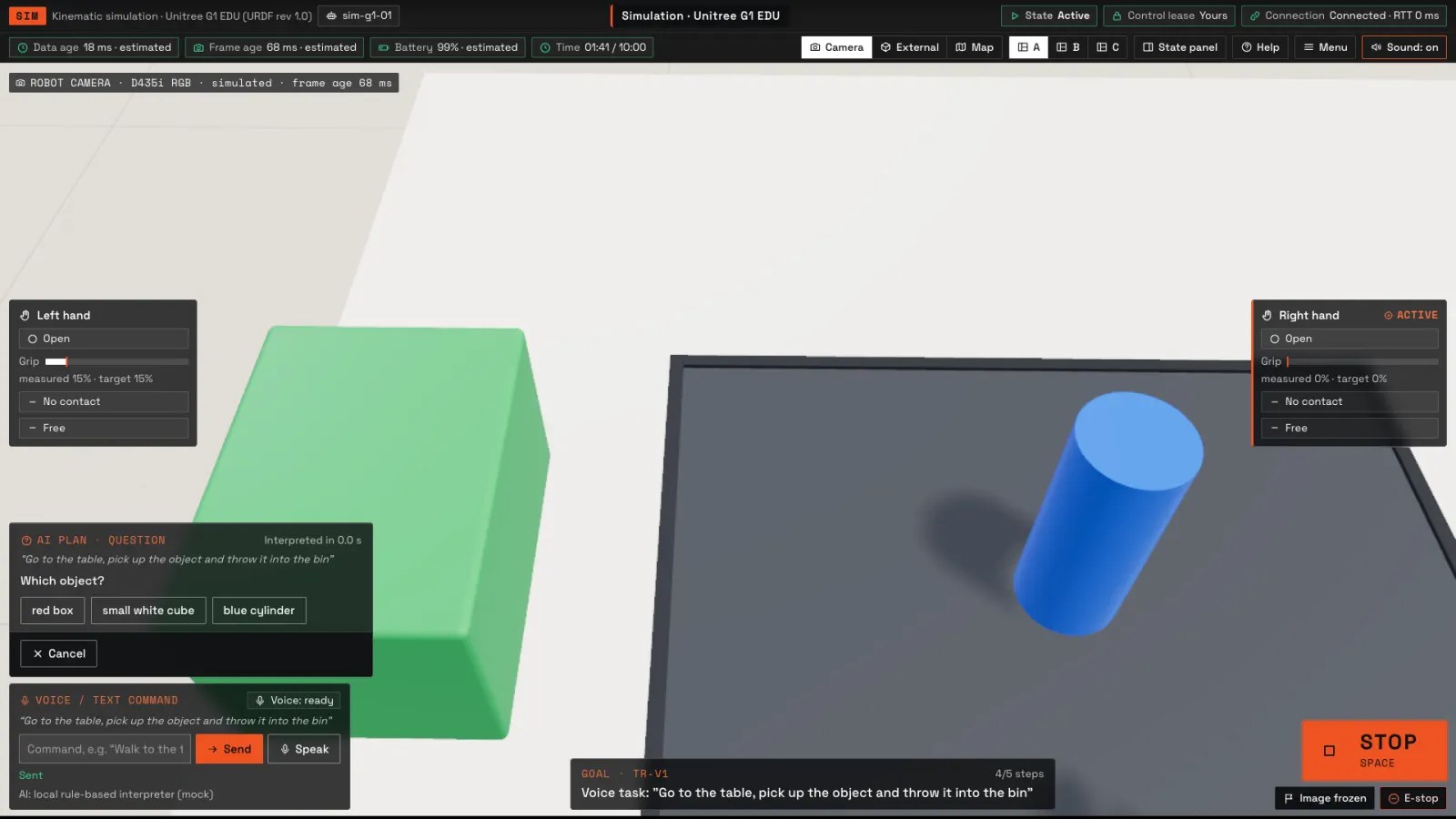 Simulation – real application recording
For an ambiguous command it does not guess: it asks which object.
The plans in the images were written by a local rule-based mock assistant. The real Claude interpretation measured 2.7–5.1 s after warm-up and about 10 s cold. Manual control always remains.
Five deployment modes; the public website and demo always stay outside the system boundary.
Tell us the robot model, the use case and the working environment – we prepare the first meeting from that.